
Nestlé’s Natural Cocoa Powder With Less Sugar and No Chemicals
The modern consumer wants healthier products with less sugar, cleaner ingredient lists without synthetic additives, premium and rich looks, and the same great taste they’ve always loved.
It’s a tall order that’s pushing food and beverage companies to rethink centuries-old processes. Health consciousness is mainstream now.
Parents scrutinize nutrition labels before buying children’s beverages, while adults increasingly limit their sugar intake to manage weight and reduce diabetes risk.
Simultaneously, the “clean label” movement demands products made with recognizable, minimally processed ingredients. Chemical-sounding additives that were once standard are now red flags for consumers seeking authenticity and transparency in their food.
This shift presents a particular headache for cocoa manufacturers. Cocoa powder is naturally bitter, making it challenging to create palatable chocolate beverages without generous amounts of sugar or artificial flavorings.
The industry’s traditional workaround—alkalization—solves the bitterness problem but introduces potassium carbonate or other alkali salts that consumers increasingly view as undesirable chemical treatments.
The Global Stakes
Coffee ranks 2nd most consumed drink worldwide behind Tea, 3rd if you count Water. 2.5 billion cups of coffee are drunk everyday throughout the world.
Then there is confectionery and baked goods where cocoa powder also gets used. And Nestle is heavily involved in all these segments.

Source: Nescafe
With such big stakes for Nestlé, meeting evolving consumer demands isn’t just about staying relevant; it’s about maintaining market leadership in a multi-billion dollar category.
When health trends threaten core product categories, companies must innovate or risk losing customers to competitors offering “better-for-you” alternatives.
The challenge intensifies because reformulation isn’t simply about removing sugar; it requires maintaining taste quality that consumers expect from established brands.
The Bitter Truth About Cocoa
Nestlé’s patent application identifies the core problem. Cocoa contains approximately 2% theobromine and 0.2% caffeine. These compounds contribute significantly to its characteristic bitter taste.
When manufacturers reduce sugar in chocolate beverages to create healthier options, this bitterness becomes overwhelming and unpleasant. Traditional natural cocoa processing does nothing to address these bitter compounds.
The conventional solution has been alkalization or Dutch process cocoa, where cocoa nibs are treated with alkaline solutions like potassium carbonate before roasting. This process darkens the color and mellows the flavor, making cocoa more palatable with less sugar.
However, it contradicts clean label principles because it involves chemical treatment.
Even though consumers seeking “natural” products actively don’t really avoid alkalized cocoa, the industry is constantly looking for better alternatives for multiple reasons.
This matters because the food industry faces mounting pressure to reduce sugar across all categories. Excessive sugar consumption links to obesity, type 2 diabetes, and cardiovascular disease.
Pressure and Water: A Chemical-Free Solution
Nestlé’s patented method offers an elegant workaround of using pressure-boiling to extract bitter compounds without any chemical additives. The process works by placing cocoa nibs in water inside a closed vessel and boiling them under pressure ranging from 1.5 to 4 bar for 10 to 60 minutes.
This pressurized environment forces water to penetrate the cocoa nibs more effectively than normal boiling, dissolving and extracting theobromine and caffeine.
After boiling, the nibs are filtered to remove the bitter-compound-laden water, which is then discarded rather than recirculated. The filtered nibs retain 30-80% moisture and proceed to standard roasting and grinding to produce cocoa liquor and eventually cocoa powder.
Nestlé’s testing showed that pressure-boiled cocoa contains approximately 50% less caffeine (0.1% vs. 0.2%) and theobromine (0.88% vs. 2.01%) compared to conventionally processed natural cocoa.
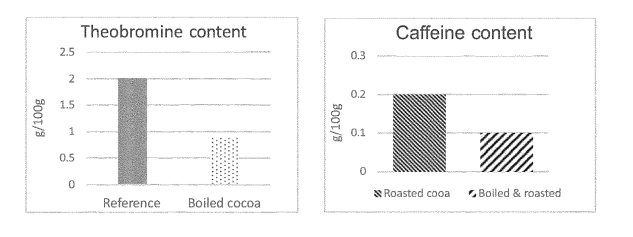
This dramatic reduction in bitter compounds means chocolate beverages can be formulated with significantly less sugar while maintaining acceptable taste.
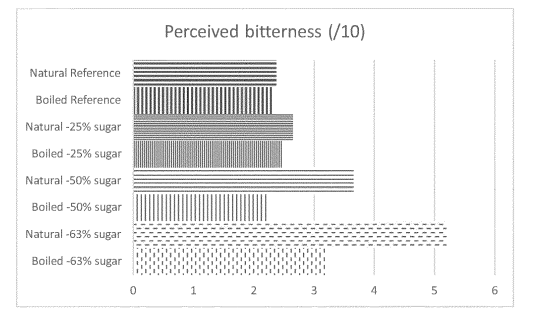
And the bonus, the pressure-boiling process also darkens the cocoa powder naturally. It achieves a color profile typically requiring alkalization, but through purely physical extraction. It’s a two-for-one innovation: reduced bitterness and darker appearance, both without chemicals.
Why This Patent Matters for Nestlé’s Bottom Line
The business implications extend beyond meeting consumer preferences. Sugar reduction has become regulatory reality in many markets, with governments imposing sugar taxes and mandating reformulation targets.
Nestlé’s testing demonstrated that beverages made with pressure-boiled cocoa maintained taste quality even at 50-63% sugar reduction, while beverages using untreated natural cocoa became unacceptably bitter at those same reduction levels.
This technology allows Nestlé to market products as both “natural” (no alkalization chemicals) and “reduced sugar” (50%+ less sugar) without sacrificing taste. If granted, the patent protects this competitive advantage, potentially blocking competitors from using similar pressure-extraction methods for up to 20 years.
For a company selling chocolate beverages globally, even small improvements in formulation translate to massive scale. Reducing sugar content lowers ingredient costs, while clean-label positioning can command premium pricing. The solution could also open opportunities in children’s nutrition products, where parents particularly scrutinize sugar content and artificial ingredients.
Nestlé’s pressure-boiled cocoa innovation represents food science solving real-world consumer tensions. By extracting bitter compounds through physical processing rather than chemical treatment, the company threads the needle between health demands and taste expectations.