Samsung’s UWB Earbuds Patent Isn’t About Better Sound
Wireless earbuds have improved dramatically over the past decade. Battery life is longer, audio codecs are more efficient, and features like active noise cancellation and spatial audio are now common even in mid-range products.
Yet, despite all this progress, problems refuse to disappear: audio dropouts, left–right desynchronization, unstable connections in crowded places, and awkward handovers when one earbud temporarily disconnects.
Samsung’s patent on UWB-enabled earbuds does not try to solve these problems by tweaking sound quality or adding a flashy new consumer feature.
Instead, it targets the underlying wireless architecture that true wireless earbuds depend on. The invention focuses on how earbuds communicate, coordinate, and recover when conditions are less than ideal, which is most of the time in the real world.
Why does the Current Earbuds Struggle?
Most modern true wireless earbuds rely almost entirely on Bluetooth. Bluetooth handles everything: audio streaming, control signals, synchronization between the left and right earbuds, and communication with the phone or other source device.
This creates a fragile setup.
Typically, one earbud acts as the “master,” receiving audio from the phone and relaying part of it to the second earbud.
If the master earbud experiences interference, signal loss, or power fluctuations, both earbuds suffer. This is why users still experience audio cutouts while walking through busy areas like airports, train stations, or shopping malls.
Even newer technologies like Bluetooth LE Audio improve efficiency but do not fundamentally change this structure.
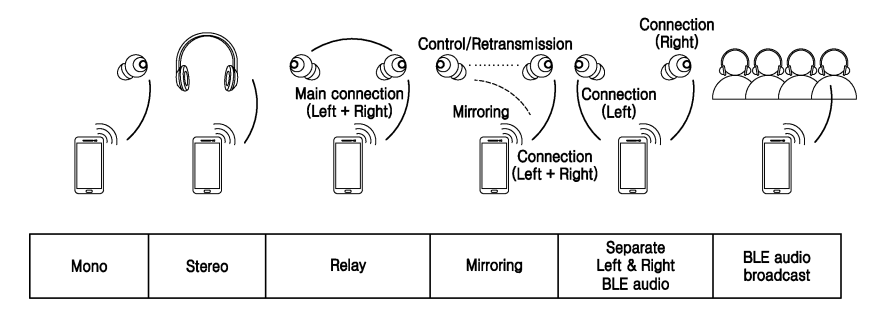
Bluetooth is still doing too many jobs at once, including tasks it was never designed to handle with extreme precision, such as tight microsecond-level synchronization between two independent devices worn on opposite ears.
Samsung’s patent starts from this problem rather than from sound quality metrics.
Samsung’s Solution: Splitting Wireless Responsibilities
The central concept in Samsung’s patent is simple but significant: stop forcing Bluetooth to do everything.
Instead of relying on a single wireless protocol, the system divides responsibilities between two technologies:
- Bluetooth is used primarily for audio delivery from the source device.
- Ultra-Wideband (UWB) is used for control, timing, synchronization, and coordination between the earbuds.
UWB is not new to consumer electronics. It already exists in smartphones for precise location tracking and secure device interactions. What is new here is how Samsung proposes to use UWB inside the earbuds themselves, not for tracking, but for managing how the earbuds behave as a system.
According to the patent, the earbuds establish a UWB connection with each other while maintaining Bluetooth connections with the source device. Control messages, scheduling instructions, and role management are routed through UWB, while audio data continues to flow via Bluetooth .
This separation reduces congestion, improves timing accuracy, and makes the system more resilient to interference.
How the System Works in Simple Terms
In practical terms, Samsung’s design treats the earbuds less like accessories and more like coordinated network nodes.
First, the phone establishes a Bluetooth connection with the earbuds, just as it does today. Then, the earbuds set up a UWB link between themselves. This UWB link acts as a private, high-precision communication channel dedicated to coordination.
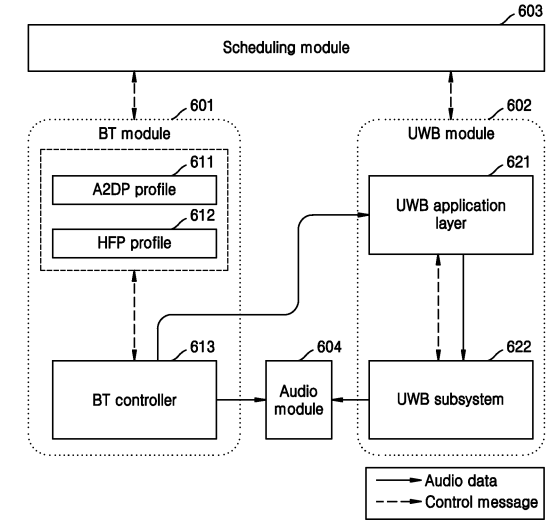
Audio data flows from the phone over Bluetooth. Meanwhile, the earbuds use UWB to decide who plays which audio channel, how timing should be aligned, and when roles should switch if conditions change.
If one earbud’s Bluetooth connection weakens or drops, the system can quickly reorganize itself using UWB-based control messages. This reduces audible glitches and avoids the abrupt silence users often experience today.
The patent also describes scheduling modules that determine how and when data is transmitted. This allows the earbuds to anticipate problems instead of reacting too late. This is a key difference from current designs, which tend to respond only after a connection has already degraded.
Samsung’s Long-Term Strategy Groundwork
One of the most overlooked aspects of this patent is what it enables beyond traditional earbuds.
By offloading coordination to UWB, Samsung lays the groundwork for more complex audio scenarios. These include shared audio experiences where multiple users listen to the same source with precise synchronization, spatial audio systems that must align sound with head movement in real time, and extended reality applications where audio timing must match visual input exactly.
In these scenarios, even small timing errors break immersion. Bluetooth alone is not well-suited for this level of precision. UWB, with its accurate timing and low-latency characteristics, is a better fit.
This suggests the patent is less about the next pair of earbuds and more about preparing audio hardware for future device ecosystems.
At a glance, this patent may seem like a technical optimization rather than a breakthrough. It does not promise louder sound, deeper bass, or new gesture controls. However, its importance lies in what it changes structurally.
No major consumer earbuds on the market today use UWB for real-time earbud-to-earbud coordination. Existing implementations, including premium models, still depend on Bluetooth for synchronization and control. Samsung’s proposal introduces a second wireless layer designed specifically for precision and reliability.
This approach addresses failure cases rather than ideal conditions. It is built for environments where current earbuds struggle most.