

Apple’s Emergency SOS via satellite, introduced with iPhone 14, lets users contact emergency services even when cellular and Wi-Fi networks are unavailable. Since launch it has been repeatedly credited with helping rescuers find people in remote and dangerous situations.
Reports and industry writeups document multiple rescues that used the feature to deliver GPS coordinates or distress messages to emergency responders.
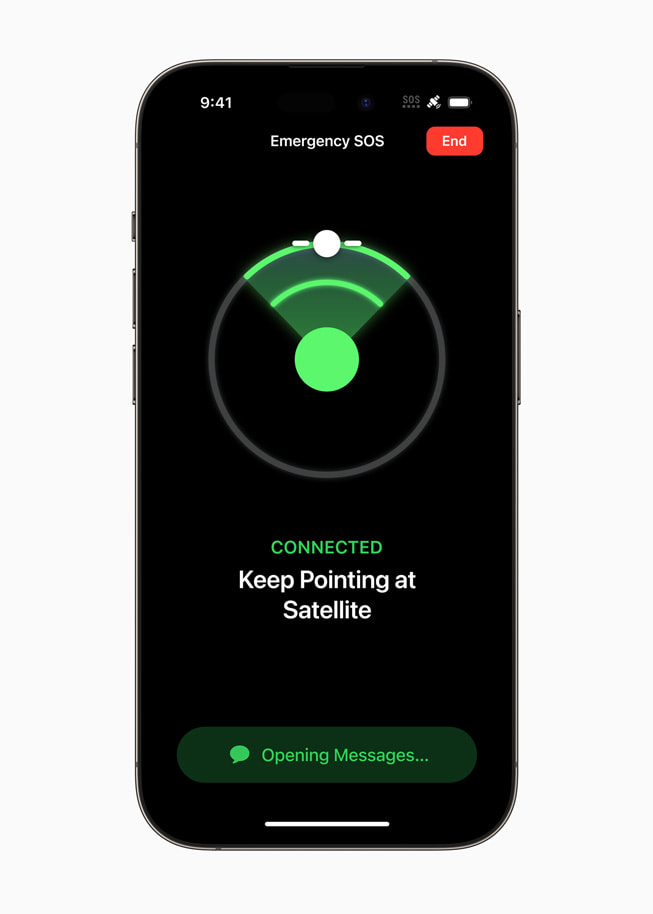
The feature’s public value has been recognized by Apple itself — the company invested heavily to build the infrastructure for it and has extended free access periods to encourage adoption.
That success is important context: Emergency SOS is already useful and has real-world validation.
Now, Apple wants to use this communication for other purposes and for it needs to solve a lot of problems.
One Apple patent application suggests that the company is working to strengthen the system so messaging remains secure and reliable even when networks switch or fail entirely.
Shortcomings of the Current Approach
Emergency SOS via satellite focuses on getting a short, critical message through when all else fails. It is optimized for safety-first, sparse prompts, short messages, and routing to emergency centers. This design is excellent for helping rescuers locate people quickly, but it is not optimized for richer, continuous, or business-critical secure messaging when networks are unreliable.
In particular, the patent frames three interconnected challenges:
Continuity of secure communication when networks fail
Typical end-to-end encryption relies on live key exchanges or online servers. If one device becomes unreachable, that leaves either no message delivery or weaker safeguards. The patent addresses how to keep encryption intact when a device switches from on-grid (cellular/Wi-Fi) to off-grid (satellite) networks.
Key management without live connectivity
If a sender must encrypt a message when the receiver is offline or the internet is down, the system still needs a way to derive keys so the recipient can decrypt the message later. The patent discusses storing sender keys and deriving message-specific encryption and later decryption are possible even when immediate key exchange is impossible.
Security across mixed routing paths
Messages may traverse multiple networks or intermediaries (satellite relays, carrier gateways). The patent considers how to ensure intermediate networks cannot access plaintext, nor replay or tamper with messages in ways that would break security guarantees.
In short, the patent treats the network handoff as a security problem, not only a connectivity problem.
Apple’s Solution
Apple’s patent describes a way for devices to keep messages secure even when normal networks are unavailable and communication has to rely on satellites.
The core idea is simple: instead of depending on live internet connections to secure messages, Apple wants devices to prepare in advance.
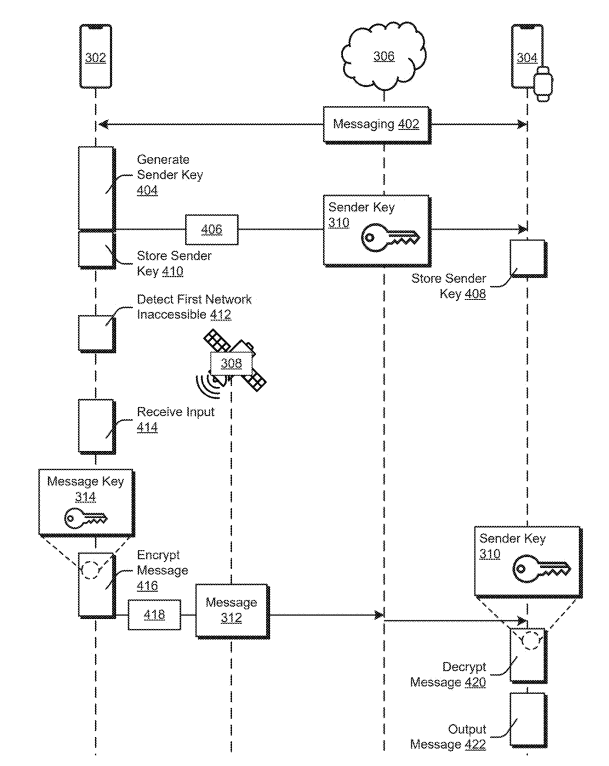
Before any network problem occurs, Apple devices generate and store special security keys on the device itself. These keys act like a secure foundation that can later be used to lock messages.
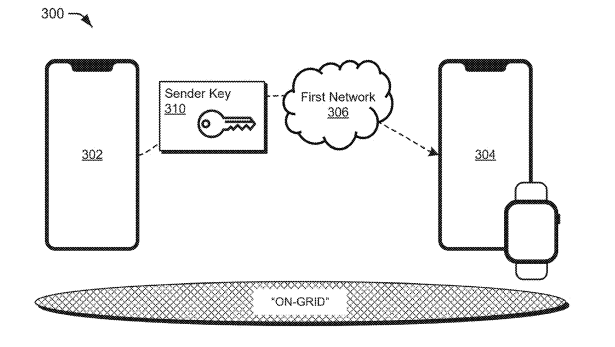
When a user tries to send a message and the phone realizes that cellular or Wi-Fi networks are not available, it does not wait for a server or another device to respond. Instead, the phone encrypts the message on its own using the stored keys.
Once the message is encrypted, it can be sent over any available network, including a satellite connection. Even though satellites and intermediate systems help deliver the message, they cannot read or understand its contents. The message remains locked during its entire journey.
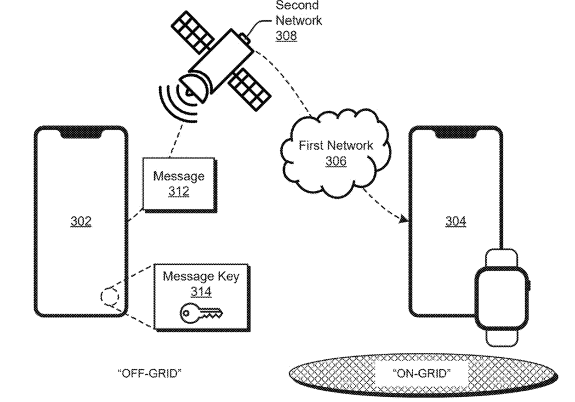
When the message reaches the receiving device, that device already has the correct key needed to unlock it. The message is then decrypted locally, without involving any third party. This ensures that only the sender and the intended receiver can read the message, regardless of how unreliable or fragmented the network path was.
Future Outlook
With this secure communication, Apple can broaden emergency services. It could expand satellite communication beyond terse SOS prompts into secure, richer exchanges (location + short audio + medical info) that remain private.
It could also help companies operating in remote areas (offshore, mining, logistics) to use this for secure operational messaging during outages.
Further, Carriers and satellite providers could partner with Apple to offer premium secure off-grid messaging for first responders, logistics fleets, and outdoor-tourism operators.
Because the system emphasizes client-side cryptography, Apple (or partners) can offer robust privacy-preserving services without exposing message content to intermediaries.
This solution fulfills the core messaging of Apple, i.e. privacy.