

In search engines, Google still has a kind of monopoly but people are getting frustrated with its results for quite some time.
In the chart below, you can see the downward trends in Google search engine market from the last couple of years.
At the same time, Bing saw an upward trend. Google didn’t lose much and Bing didn’t gain much but it is significant loss and gain for both.
Source: StatCounter Global Stats – Search Engine Market Share
AI platforms further made things a little bad for Google. That’s why users have had many discussions on Google’s bad outputs.
And with Generative AI trending, Google in the last couple of years has done quite a change in its search output for better or worse.
Earlier, we covered the “Beyond AI Mode” feature that Google could bring soon in its search results that favors search ad links over organic.
Read Here: Beyond AI Mode: Google To Add AI Chat to Search Results
Makes sense since it’s how Google mostly makes money.
And we found another proof that Google is planning to implement another change in its search result using Generative AI.
A new Google patent application points toward another shift. It describes how generative AI can change not what is ranked, but how results and paid content are organized and explained to the user.
As per the patent, the focus isn’t better answers but better formating. With this new formatting, search results will look less like a list of blue links and more like a structured map of choices that mirror how humans actually make decisions.
The problem Google is trying to solve
When people search, they usually aren’t hunting for one magic webpage. They’re navigating a small universe of options. A search such as “replace Pixel 4XL screen” hides multiple possible intents:
- get professional repair
- buy parts for DIY
- read a guide before deciding
- compare service costs
Today, search engines typically scatter these outcomes across ads, snippets, and organic links. Users must mentally piece everything together like assembling Ikea furniture without the manual. Sponsored results, meanwhile, often appear as disconnected ads rather than clearly contextual options tied to specific user goals.
The patent frames this as an inefficiency: systems present information, but they do not organize the decision space. Users click back and forth, advertisers shout into the void, and neither truly meets the other in the middle.
Generative AI is the missing glue.
The proposed solution: category-based AI search formats
The patent proposes a pipeline built around two AI models:
- one model groups the user’s query into meaningful categories
- another model writes human-readable descriptions for each category
The system first receives the search query. It then generates categories that represent the different paths a user might take. These aren’t arbitrary clusters; they are grounded in likely user intent. For the Pixel screen example, the categories might include:
- professional repair services
- DIY repair options
- replacement parts and kits
Once the categories exist, the system retrieves sponsored content options relevant to each category. Instead of generic ads floating around the page, ads become attached to specific intent buckets.
This reduces ambiguity. A repair shop link doesn’t appear as a random ad; it appears inside “professional repair services,” where it plainly belongs.
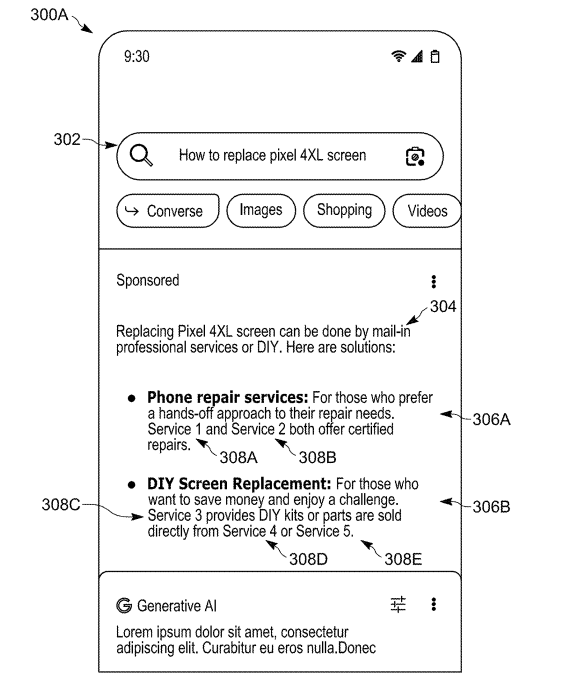
The second AI model then generates free-form descriptive text explaining each category. These small paragraphs are the secret sauce. They explain choices, outline trade-offs, and set expectations.
What the experience looks like in practice
Imagine typing “how to replace Pixel 4XL screen” into Google. Instead of a familiar vertical list, you see structured sections.
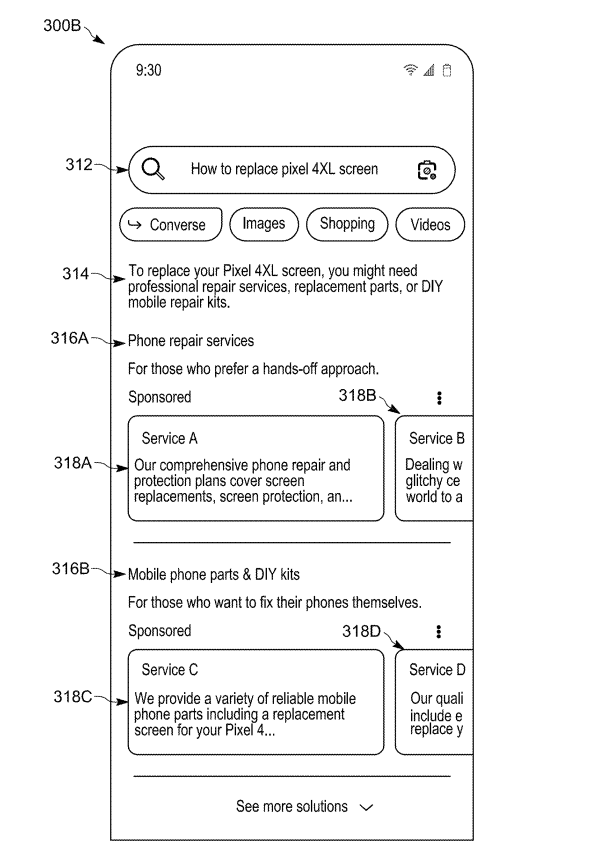
One section explains professional repair services, summarizing how they work and why someone might choose them, followed by sponsored repair providers. Another section describes DIY replacement and links to kits and guides. A third presents parts suppliers, with brief AI-written guidance about compatibility and tools.
Nothing magical has happened to the web. What changed is the format—and, critically, cognitive load. The system has mapped the problem space for you before you choose a path inside it.
Why this matters for users and advertisers
For users, this approach reduces the “pogo-stick” experience of jumping between tabs and backtracking. It aligns with how humans naturally think: “Do I fix it myself, or do I pay someone?” Instead of decoding pages of mixed results, users see their options laid out in different categories.
For advertisers, this could be equally consequential. Sponsored content stops functioning as generalized static ads. Instead, it becomes part of a curated option set linked to explicit user intent. Relevance becomes structural rather than superficial. A repair shop doesn’t just bid on keywords; it gets slotted into the “professional repair path” a user is already considering.
With this patent/feature, Google doesn’t just tweak interface design but tries to signal where search is drifting.
As AI search queries are increasing, the users are going toward action-oriented results rather than getting links. Instead of asking users to interpret the web, the system interprets with them, or even a step ahead of them.
There are also implications for trust and responsibility. Generative explanations will need to be accurate, neutral, and transparent about what is sponsored. Misplaced confidence in generated summaries could easily mislead users, so evaluation and guardrails remain as important as innovation.
Still, the direction is clear. Search results are evolving from lists into narratives about possible futures: hire, buy, learn, or do nothing yet. The internet becomes less of a maze and more of a map.
Generative AI, in this vision, could do more than just producing answers.