

When it comes to maps, Google Maps is the preferred choice for most people. And it’s reasonable since their app is the best for several reasons.
You might not know that Microsoft also has a similar application to Google Maps. They call it Bing Maps. Bing Maps has been around for the last 20 years, but it has rarely made any headlines like Google Maps or Apple Maps.
Microsoft has been competing with Google Maps for a long time, but there is still a huge gap between them.
In May 2024, Microsoft announced that it’s retiring Bing Maps for Enterprise and consolidating all enterprise mapping services under Azure Maps, its next-generation cloud-based platform. This represents a strategic pivot from trying to build a direct consumer alternative to focusing on enterprise customers and developers who need scalable, location-based services.
The transition marks Microsoft’s acknowledgment that competing head-to-head with Google Maps in the consumer space has proven challenging.
Bing Maps Feature
Over the past years, Microsoft has invested in specific technical advantages for Bing Maps. The platform offers unique features, including bird’s-eye view imagery, “Along the Route” point-of-interest alerts across multiple categories, elevation information, and robust spatial analytics capabilities.

Source: Bing Blog
Bing Maps also demonstrates better API performance in some scenarios, with developers noting that Bing’s API is more flexible for implementing custom requirements.
However, progress has been uneven. While Microsoft has a few unique features, Google has tons of them.
That’s why Microsoft is making a desperate attempt to bring new features to its maps to make them relevant.
What is Microsoft cooking?
Microsoft targets a solution that is not to give the fastest route, but a route that you are most likely to pick, even though it takes slightly more time than the fastest routes.
Take this scenario to understand better.
Say, you’re going for a drive and you want to take “the scenic off-route along the coast” or “a highway near downtown which takes you to your destination faster.” But when you open your map app, you’re stuck toggling between “Fastest Route” and “Shortest Route”.
And here’s Microsoft wants to make an impact.
Microsoft’s Solution is a Simple one
Microsoft’s patent application describes something genuinely simple yet innovative: a routing system that treats finding your route as a search problem rather than a math one.
Here’s how it works:
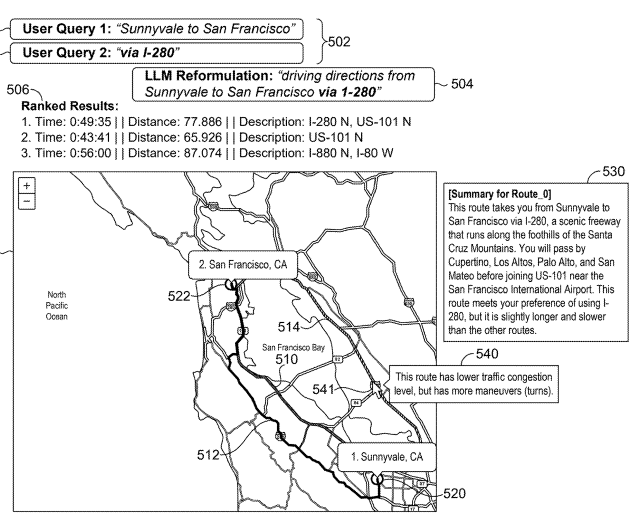
When you type or speak something like “Take me from home to the office, but go through downtown and avoid highways,” the system uses a large language model to actually understand what you’re asking for.
It picks up on both the obvious stuff and the subtle preferences (maybe you’ve told your digital assistant before that you like scenic routes).
Then comes the clever part.
Instead of just calculating routes based on time and distance, the system creates a detailed “profile” for every possible route.
Each route gets tagged with attributes: which specific roads it uses, whether there are tolls, if it’s scenic, how much highway driving is involved, and even whether you’ve taken parts of that route before.
Finally, the system ranks all possible routes against your request.
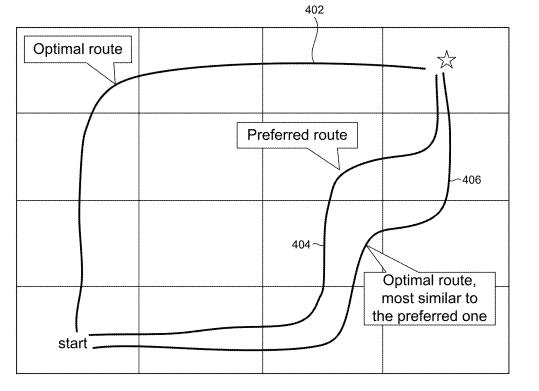
This approach bridges the gap between how humans naturally communicate and how computers process information.
Right now, if you want a specific type of route, you’re basically negotiating with your GPS app. You drag waypoints around on the map, toggle settings, and hope the algorithm figures out what you want. With Microsoft’s system, you just… tell it. In plain English (or any other language).
The system can also explain its reasoning. Instead of just showing you three blue lines on a map, it might say “Route 1: Takes Main Street as requested, avoids highways, adds 8 minutes” or “Route 2: Includes the coastal road you mentioned, very scenic”. That’s the kind of transparency that actually helps you make decisions.
When Will This Feature Come?
For regular users, this technology would show up in Bing Maps, but it is hard to say when. It is a patent application and not granted, so it might take time.
That said, patents like this often signal where the entire industry is headed. If Microsoft successfully implements this, you can bet Google and Apple will be working on their own versions. Apple’s already experimenting with natural language search in Maps.
Apple added natural language search to Apple Maps in iOS 26, which lets you search for things like “cafes with free Wi-Fi”. But that’s just for finding destinations; it doesn’t help with how you actually get there.
The bigger question is whether Microsoft can execute on this vision. They have the AI technology. But they’ll need to convince developers and users that their mapping platform is worth paying attention to again.
Recently, they have been able to increase their share in the search engine market; maybe they can increase their market share here as well, if they play it right.