
Most AI chats are still short-sighted. Close the window and they forget everything.
Start a new one, and it’s as if the assistant has never met you. That’s tolerable when you’re asking for the weather. It’s maddening when you’re planning a product launch, studying for exams, or managing household projects.
There’s a second headache, too: intention. People rarely speak in perfect prompts. We say things like “Can you make a plan for a marketing presentation?” or “Fix the issues in a report?”
A human colleague would ask clarifying questions or recall last week’s files. Many AI systems respond with generic advice or guesses. The result is friction back-and-forth messages, repeated context, and answers that don’t quite match what you meant.
Samsung’s patent application targets both problems. It doesn’t reinvent the entire AI model. It reorganizes the way chat happens—how context is stored, how questions are interpreted, and how answers are delivered. Think of it as smarter scaffolding around the model so the model can do its best work.
Samsung’s Solution: A Chat that Remembers
At the heart of Samsung’s idea are two kinds of chat spaces:
- General chat for one-off questions.
- Project chat for anything that lasts longer than a coffee break.
When you ask the first question, the AI will give you an answer in a General chat. Then it will show you an option to transition to a project chat where you tell the system how long the project will run, i.e. a week, a month, or a quarter.
During that period, the assistant keeps your context alive: previous conversations, attached files, decisions you’ve made, and milestones you agreed on. Instead of resetting to zero, it behaves like a teammate who shows up prepared.
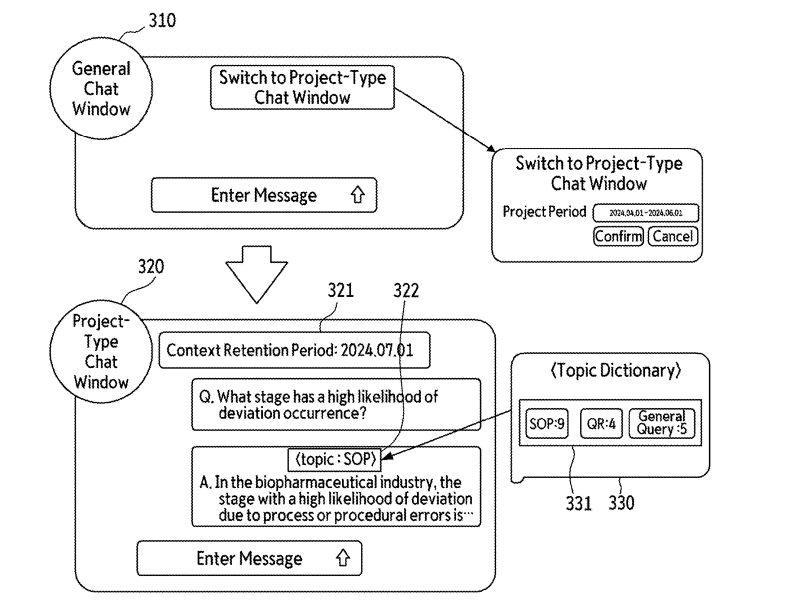
Within that project, you can set topics such as “budget,” “marketing plan,” or “timeline.” The assistant then routes your questions to the right topic, automatically pulling in earlier messages, documents, and relevant details.
Ask “Update the estimate based on last week’s vendor quote,” and it knows “estimate” lives under budget, “vendor quote” came from a PDF you shared three days ago, and “last week” maps to a specific message thread. No more hunting for links. No more re-explaining.
Under the hood, the system composes a smart prompt each time you ask something. Samsung’s patent describes a way to build this prompt dynamically, mixing your current question with stored project context and topic-specific notes. That’s how it gets answers that feel tailored rather than generic: the AI is briefed with the right background before it speaks.
Do similar capabilities already exist?
Yes, pieces of this exist across several assistants.
- OpenAI (ChatGPT)
- Opt-in, cross-chat Memory (remembers preferences/details across sessions) and user controls to view/clear memories.
- Custom GPTs let you create topic-scoped assistants with fixed instructions/knowledge, which is close to “topic-constrained chat windows.”
- Google (Gemini)
- Recently added personalization via past chats plus Temporary Chats that don’t persist or affect memory—closest market analogue to explicit retention control, though it’s a “don’t save” switch rather than “remember for N days.”
- Anthropic (Claude)
- Projects give you scoped workspaces (topic-bounded memory + files) and new automatic memory for Teams/Enterprise—again, similar in spirit to topic scoping and cross-session context.
However, in Samsung case, the novelty is the particular combo + UX framing (especially the user-chosen retention window).
Time-boxed memory per chat:
Samsung’s patent offers a memory limit in a time period. Others offer either global memory (ChatGPT, Claude, Perplexity) or “don’t retain this” modes (Gemini’s Temporary Chats). Allowing a user-specified retention period for a specific chat is less common and is likely where Samsung’s patent tries to draw a line.
Topic-constrained chats:
Conceptually same as Custom GPTs or Claude Projects (scoped instructions/knowledge), but Samsung frames it as a chat window that induces designated topics. That’s a UX nuance rather than a fundamentally new capability.
Samsung’s differentiator is the explicit, user-controlled retention window per chat combined with topic-inducing chat UIs and automatic vocabulary normalization in one coherent flow. That’s a distinct product design + patentable UX pattern, not a brand-new LLM capability.
How Samsung could deploy this—without reinventing the model
Samsung doesn’t need to build a brand-new large language model to pull this off. The patent describes an orchestration layer that can sit on top of existing models from OpenAI, Google, Anthropic, or others. The value is in the integration—how deeply the system plugs into your documents, your device, and your daily flow.
Enter Galaxy AI. Imagine this shipping as part of Samsung’s ecosystem:
- Bixby gets sticky memory. Ask Bixby to draft the “Q4 budget update” in your project chat, and it remembers last week’s numbers, the cost center codes in your spreadsheet, and your manager’s comment to cap travel at a specific amount.
- Samsung Notes becomes a living workspace. Notes tied to a project chat can autofill summaries, cite exact documents, and keep a running change log.
- Files and Gallery become sources, not just storage. The assistant can pull facts from a PDF on your tablet, a chart saved on your phone, or a photo of a whiteboard from last Tuesday—then link back to the original.
- Cross-device continuity feels natural. Start a “marketing plan” topic on your laptop, ask a quick “timeline” question on your phone during a commute, confirm a number on your TV during a presentation—same project, same memory.
- Smart appliances play along. A “home renovation” project chat could coordinate appliance specs from the fridge to the washer, keep track of measurements, and remind you which models match the budget topic.
Because the orchestration layer is model-agnostic, Samsung could swap in different AI backends based on task, privacy, or cost—one model for summarizing documents, another for coding, another for translation—while keeping the user experience consistent.
The bottom line
Samsung’s patent sketches a scenario where AI stops acting like a forgetful chatbot and starts behaving like a project-savvy partner. By remembering what matters for as long as the work lasts, organizing conversations by topic, and composing smarter prompts behind the scenes, the system tackles the real reasons AI feels unreliable today.
If Samsung threads this into Galaxy AI across phones, tablets, laptops, TVs, and appliances, it could create a continuous, personalized layer that understands you and your work over time. That’s the difference between an assistant who answers questions and one who actually helps you get things done.